AI's Growing Role in Engineering Draws Varied Global Coverage
Outlets across Africa, Asia, Europe and North America are reporting on AI's growing role in engineering, education and finance, but they differ sharply in what they emphasize, from job-market disruption to classroom adaptation to philosophical debate.
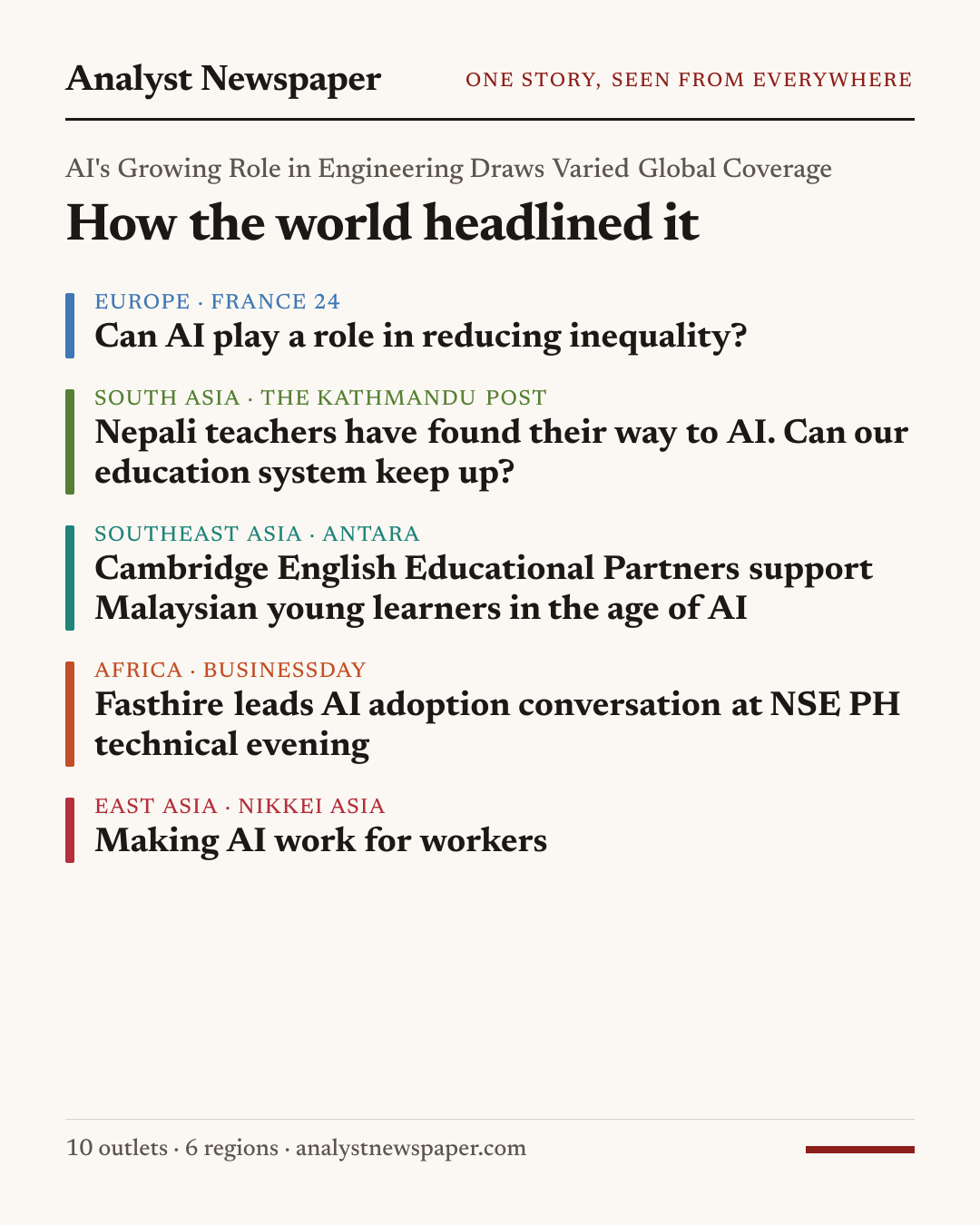
What happened
Outlets in Nigeria, India, Malaysia, Nepal, the UK, the US and elsewhere are reporting on how artificial intelligence is reshaping engineering practice, education and related professional fields.14578910
Coverage includes a Nigerian industry event urging engineers to adopt AI, a CNBC report on surging Wall Street demand for AI 'agent orchestration' skills, and debates in Indian and Malaysian outlets over how engineering education should adapt.1489
Other coverage touches on AI's effect on mathematics, software engineering practices, and broader questions about AI's role in reducing or worsening global inequality.3710
What's agreed
Reported consistently by outlets in more than one region.
- Multiple outlets report that AI is changing how engineers and engineering students work and are trained, from coding practices to education curricula.18910
- Coverage from different regions frames AI adoption in professional and educational fields as significant and advises engagement with it rather than avoidance.159
Where accounts differ
Each account is attributed to who makes it. We do not judge between them.
Whether AI's effect on fields like engineering and mathematics is primarily an opportunity or a disruptive pressure
Malay Mail (Prem Gunnasegaran)
AI in engineering education is described as an opportunity rather than a replacement for lecturers.9
New Scientist (Jacob Aron)
AI's rapid transformation of mathematics raises concern about whether refusing to use it will become untenable, described with the term 'AI refusenik'.7
Inc42
Engineering education is criticized as too narrowly focused on coding and in need of a shift toward systems thinking because of AI.8
How it's framed
What each perspective puts first, based on headlines and summaries.
| Perspective | How it reads | What it puts first |
|---|---|---|
| African professional/industry pressAfrica | Frames AI adoption as professional advice for engineers to embrace, centered on a local industry event.1 | embrace AI, professional development, industry event |
| South Asian education and technology pressSouth Asia | Focuses on how AI is reshaping classroom practice and engineering curricula, emphasizing preparation, critical use, and systems thinking over rote coding.58 | teacher preparation, critical engagement, systems thinking, beyond coding |
| Southeast Asian pressSoutheast Asia | Covers AI in education as a growing but manageable part of young learners' and university students' lives, stressing support structures and opportunity rather than threat.69 | young learners, opportunity not replacement, educational support |
| European outletsEurope | Range from public-interest debate about AI's role in global inequality and development to trade-press coverage of AI's disruptive effect on specialized fields like mathematics and software engineering practice.3710 | inequality debate, development aid, transformation of mathematics, catching up with AI agents |
| North American financial pressNorth America | Emphasizes labor-market and hiring impact, highlighting a sharp rise in demand for specific AI-related engineering skills on Wall Street.4 | hiring surge, skill demand spike, agent orchestration |
| East Asian business pressEast Asia | Covers the theme of making AI work for workers, though detail is limited in the material reviewed.2 | worker-centered AI |
What the coverage leaves out
- None of the outlets reviewed provide direct data or studies measuring actual productivity or quality changes from AI adoption in engineering work.
- None of the outlets reviewed report on regulatory or policy responses specifically addressing AI's role in engineering professions.
- The East Asian item (S2) has no snippet or detailed claims available, limiting what can be said about its specific framing.
- None of the outlets reviewed address potential job losses or negative labor market effects from AI in engineering, aside from the demand increase reported by CNBC.
Why it matters
The coverage spans finance, education, mathematics and engineering, suggesting AI's effect on professional practice is being discussed across multiple fields and regions simultaneously.4789
What to watch
- How engineering education institutions in different countries adjust curricula in response to AI capabilities.
- Whether labor market demand for AI-specific engineering skills, such as agent orchestration, continues to grow as reported by CNBC.
- Further developments in the debate over AI's role in reducing or exacerbating inequality, as raised by France 24 and the World Bank.
Sources (10)
Every outlet we drew on, grouped by where it is based. Read the originals for the full reporting.
North America
Europe
- 3France 24FRPublic broadcaster
- 7New ScientistGBPrivate
- 10The RegisterGBPrivate
Africa
- 1BusinessDayNGPrivate
Fasthire leads AI adoption conversation at NSE PH technical evening
South Asia
- 5The Kathmandu PostNPPrivate
Nepali teachers have found their way to AI. Can our education system keep up?
- 8Inc42INPrivate
Beyond Coding: Why AI Makes Systems Thinking More Important For Engineers
East Asia
- 2Nikkei AsiaJPPrivate