OpenAI releases 722 math papers from unreleased model, drawing mixed reaction
OpenAI's release of hundreds of mathematical results has impressed some observers and drawn criticism from mathematicians over verification and access, with coverage split between straightforward reporting and sharper scrutiny.
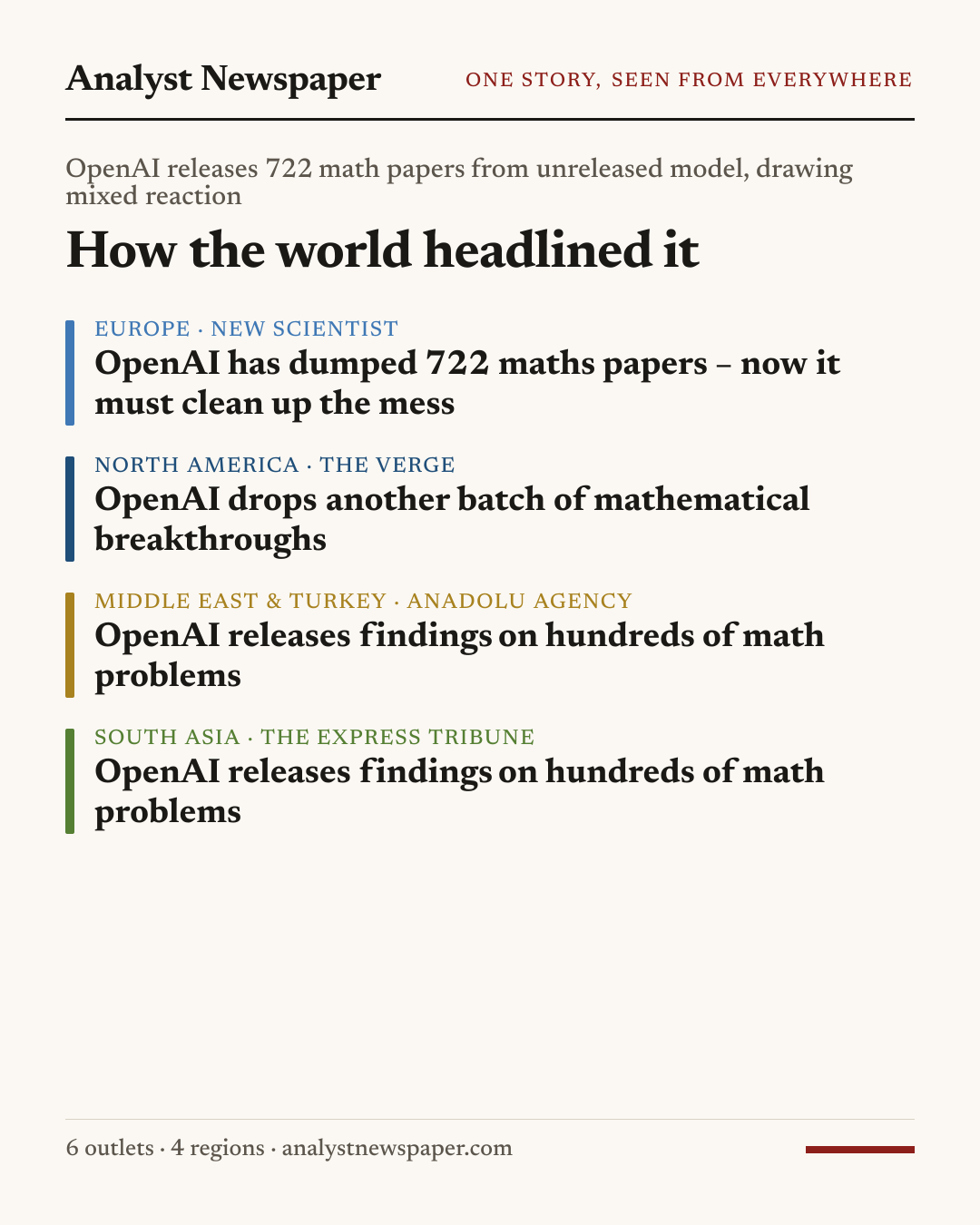
What happened
OpenAI released 722 mathematics manuscripts, covering 372 result families, produced by an unreleased frontier AI model.135
The company said the results are at different stages of verification, and the model reportedly attempted approximately 4,000 research problems during testing.24
The findings span topics including algebra, theoretical computer science and mathematical logic.5
The release has both impressed and unsettled parts of the mathematical community and raised questions about research ethics.356
What's agreed
Reported consistently by outlets in more than one region.
Where accounts differ
Each account is attributed to who makes it. We do not judge between them.
Exact scale of the release
New Scientist and The Verge
722 manuscripts were released, with The Verge specifying 372 result families.13
The Guardian Business
Over 370 mathematical results were published.5
Wired
More than 100 new solutions to unsolved problems were being prepared for release.6
The Express Tribune, citing OpenAI
The unreleased model attempted approximately 4,000 research problems during testing.4
Nature of mathematicians' concerns
New Scientist's Jacob Aron
OpenAI bears responsibility for managing the fallout of its releases rather than leaving cleanup to mathematicians.1
Mathematical leaders, via The Guardian Business
Concerns center on inadequate vetting of results and lack of accessibility of AI models to the broader mathematical field.5
A mathematician, via Wired
There is a perception of mobster behavior from leading AI companies.6
How it's framed
What each perspective puts first, based on headlines and summaries.
| Perspective | How it reads | What it puts first |
|---|---|---|
| US tech and science pressNorth America | Frame the release as both impressive and troubling, highlighting tension between technical achievement and ethical concerns raised by mathematicians.36 | breakthroughs, unsettled community, research ethics, mobster behavior perception |
| UK outletsEurope | Emphasize critical scrutiny of OpenAI's conduct, framing the release as creating problems OpenAI must address and as drawing expert concern over vetting and accessibility.15 | dumped, mess, astounded, due diligence concerns, accessibility |
| Turkish state-controlled wire and syndicated South Asian coverageMiddle East & Turkey | Report the release in largely neutral, factual terms, focusing on the scale of problems attempted and OpenAI's own characterization of verification status.24 | hundreds of math problems, verification stages, 4,000 problems attempted |
What the coverage leaves out
- None of the outlets reviewed detailed the specific methodology OpenAI used to verify or vet the mathematical results.
- None of the outlets reviewed reported OpenAI's direct response to the ethics or vetting criticisms beyond its statement that results are at different stages of verification.
- None of the outlets reviewed identified which mathematicians have reviewed or confirmed specific results as correct.
- None of the outlets reviewed named the mathematician who described a perception of mobster behavior or detailed what specific behaviors prompted that characterization.
Why it matters
OpenAI is reportedly using mathematics as a test site for its most capable AI models, part of a broader pattern of AI companies seeking high-profile demonstrations of advanced reasoning capability.1
What to watch
- Whether mathematicians independently verify the claimed solutions among the 722 released manuscripts.
- Whether OpenAI responds further to criticism over vetting and accessibility of its AI models to the broader mathematical field.
Sources (6)
Every outlet we drew on, grouped by where it is based. Read the originals for the full reporting.
North America
- 3The VergeUSPrivate
- 6WiredUSPrivate
Europe
- 1New ScientistGBPrivate
OpenAI has dumped 722 maths papers – now it must clean up the mess
- 5The Guardian BusinessGBPrivate
OpenAI’s release of mathematical findings draws concerns from experts
Middle East & Turkey
- 2Anadolu AgencyTRState-controlled
South Asia
- 4The Express TribunePKPrivate