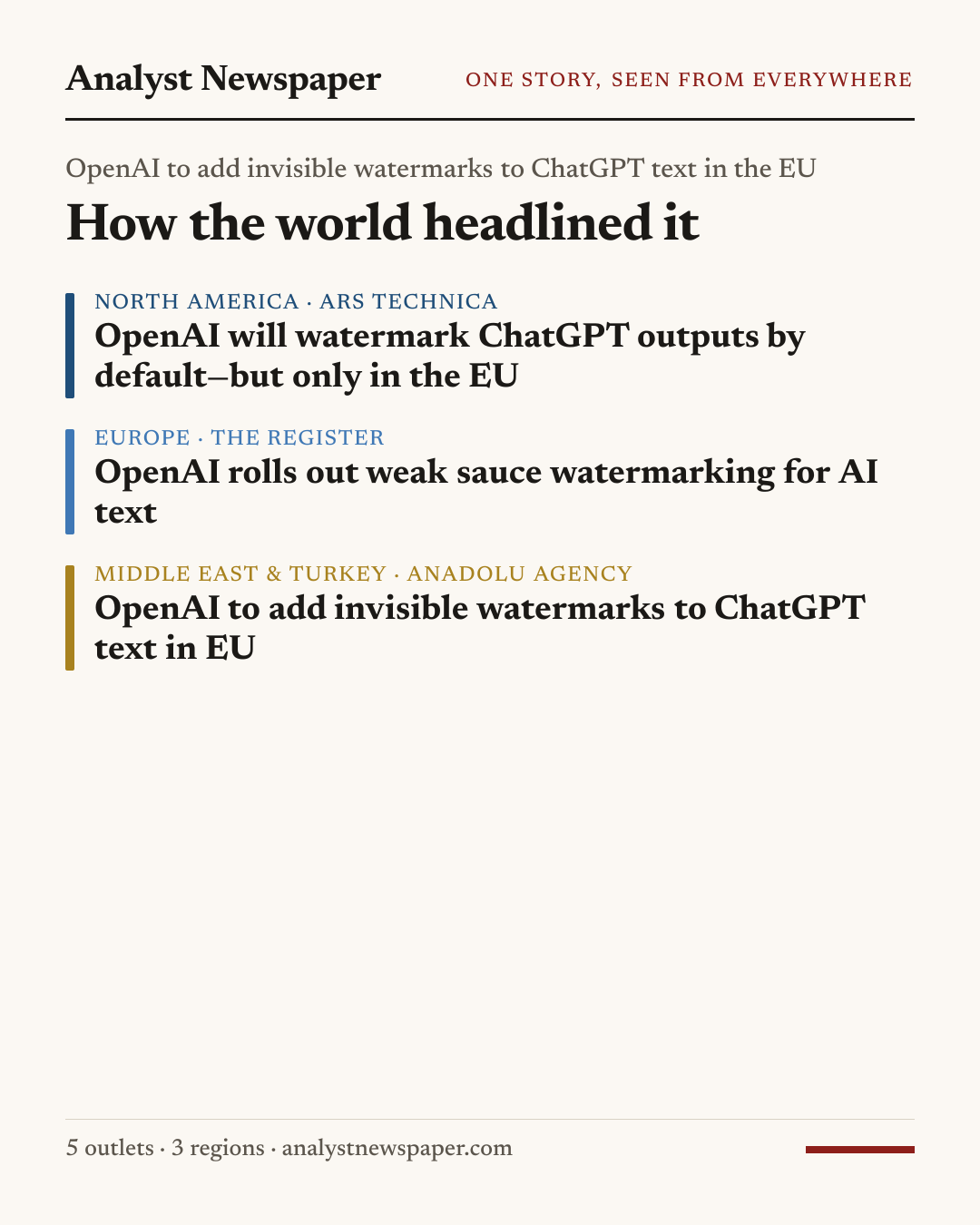
OpenAI to add invisible watermarks to ChatGPT text in the EU
OpenAI is rolling out machine-readable watermarking for ChatGPT and Codex output in the EU, but coverage differs on how effective and necessary the move is.
What happened
OpenAI is rolling out invisible, machine-readable watermarking for ChatGPT and Codex text output, starting with users in the European Union.12345
Several outlets link the change to the EU's AI Act, with Anadolu Agency and TechCrunch reporting the watermarking is required under EU law.24
OpenAI says the technology can help identify AI-generated text, but editing and short passages can weaken detection.24
OpenAI says its textGrain watermarking approach matched or exceeded other methods such as Google DeepMind's SynthID for text, which also underpins watermarking Anthropic announced in August.5
What's agreed
Reported consistently by outlets in more than one region.
Where accounts differ
Each account is attributed to who makes it. We do not judge between them.
Why OpenAI is making this change
How it's framed
What each perspective puts first, based on headlines and summaries.
| Perspective | How it reads | What it puts first |
|---|---|---|
| UK tech trade press (critical of compliance adequacy)Europe | The Register frames the rollout as a minimal or inadequate response, questioning whether it amounts to real compliance.1 | skepticism of compliance effort, loaded framing as "weak sauce" |
| Turkish state-controlled agency (regulatory compliance focus)Middle East & Turkey | Anadolu Agency presents the watermarking primarily as a response to EU legal requirements, noting OpenAI's own caveats about detection limits.2 | EU law requirement, OpenAI's stated capabilities and limitations |
| US technology press (mixed: compliance detail vs. technical skepticism vs. competitive comparison)North America | Ars Technica emphasizes unreliability and ease of circumvention; TechCrunch focuses on the AI Act compliance rationale and OpenAI's caveats; The Verge emphasizes the technical approach and OpenAI's comparison to competitors like Google DeepMind and Anthropic.345 | technical reliability concerns, AI Act compliance details, competitive positioning against SynthID and Anthropic |
What the coverage leaves out
- None of the outlets reviewed reported specific details of the EU AI Act provisions that mandate the watermarking.
- None of the outlets reviewed reported reactions from EU regulators or officials to OpenAI's rollout.
- None of the outlets reviewed reported when or whether the watermarking will expand beyond the EU.
- None of the outlets reviewed provided independent technical testing data on the watermarking's detection accuracy.
Why it matters
Sources (5)
Every outlet we drew on, grouped by where it is based. Read the originals for the full reporting.
North America
- 3Ars TechnicaUSPrivate
OpenAI will watermark ChatGPT outputs by default—but only in the EU
- 4TechCrunchUSPrivate
- 5The VergeUSPrivate
Europe
- 1The RegisterGBPrivate
Middle East & Turkey
- 2Anadolu AgencyTRState-controlled