Robotics firms worldwide advance humanoid and service robots across varied timelines
Coverage of humanoid and service robots spans elder-care companions, supermarket restocking, delivery and manufacturing, with outlets differing on how close full autonomy and commercial deployment really are.
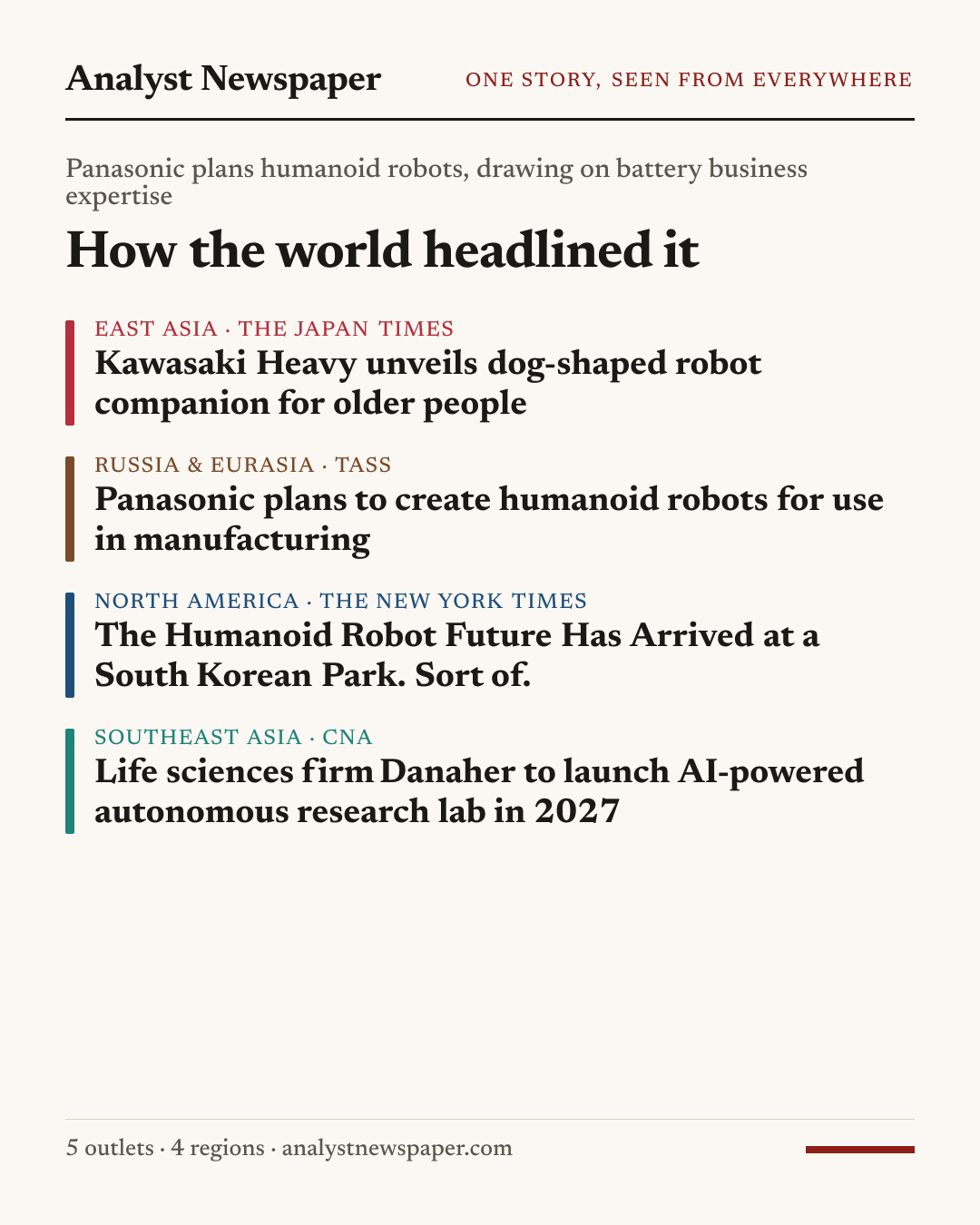
What happened
Multiple companies across Japan, China, South Korea, Denmark and the United States are developing humanoid and service robots for uses including elderly companionship, manufacturing, retail restocking and delivery.123567
Panasonic has outlined plans for humanoid manufacturing robots with potential production starting in 2029, according to company representative Akira Sakakibara, though further details remain undisclosed.2
Xpeng is ramping up production of its humanoid robot Iron and plans to deploy it in stores before offering it to external customers, alongside targets for overseas robotaxi trials, according to vice-chairman Brian Gu.6
Nvidia is developing safety infrastructure for physical AI used in robotaxis and humanoid robots, while some commentators caution that near-term practical impact of humanoid robots may be limited despite high hype.810
What's agreed
Reported consistently by outlets in more than one region.
- Humanoid and service robots are being developed and deployed across multiple countries, including Japan, China, South Korea, Denmark and the United States, for uses ranging from manufacturing to retail restocking to elderly care.12367
- Major companies including Panasonic, Xpeng and Nvidia are investing in humanoid robots and physical AI, with some targeting production or deployment timelines between 2029 and the early 2030s.2610
- Robots are increasingly being used for night-shift or off-hours work, including supermarket restocking in Denmark and autonomous deliveries in China.35
Where accounts differ
Each account is attributed to who makes it. We do not judge between them.
How close humanoid robots are to delivering practical, widespread impact
Panasonic and Xpeng executives, as reported by TASS and CNA
Company leaders describe concrete production and deployment timelines, including manufacturing robots potentially starting in 2029 and robots deployed in stores before wider rollout.26
MIT Technology Review
Describes the hype around humanoid robots as reaching fever pitch while arguing AI breakthroughs in robotics will not change people's lives any time soon.8
The New York Times
Portrays a South Korean robot park showcase as part genuine technological progress and part theatrics.11
How it's framed
What each perspective puts first, based on headlines and summaries.
| Perspective | How it reads | What it puts first |
|---|---|---|
| Japanese and East Asian outletsEast Asia | Focus on specific product unveilings and applications, such as a companionship robot for the elderly and South Korea's broader 'physical AI boom' including robot baristas and performers.17 | elder care, companionship, physical AI boom, specific product demos |
| Russian state-controlled mediaRussia & Eurasia | Reports Panasonic's manufacturing robot plans via direct corporate statements, emphasizing timelines and corporate caution about disclosing details.2 | corporate statements, production timeline, manufacturing use |
| European outletsEurope | Highlights practical retail applications, framing robots as tools to ease staff workload during demanding night shifts.3 | workforce support, retail logistics, night shift automation |
| North American outletsNorth America | Mostly straightforward industry reporting on robotics investment and startups, with individual pieces from a newsletter (S8) and a feature (S11) offering more skeptical or reflective takes on the gap between hype and real-world capability.481011 | investment and safety infrastructure, startup innovation, individual skeptical takes |
| South Asian outletsSouth Asia | Covers both Chinese robotics expansion into nighttime autonomous delivery and Indian robotics startups building foundation models for physical AI, emphasizing growth and innovation.59 | autonomous delivery expansion, industry growth, foundation models |
| Southeast Asian state-controlled mediaSoutheast Asia | Reports on Xpeng's humanoid robot and robotaxi plans through direct executive commentary, emphasizing corporate strategy and rollout timelines.6 | corporate strategy, executive interview, robotaxi expansion |
What the coverage leaves out
- S1 gives no timeline or further detail on Kawasaki Heavy's plans for its elder-care companion robot.
- None of the outlets reviewed reported regulatory responses or safety approvals governing humanoid robot deployment.
- None of the outlets reviewed addressed labor or employment impacts of robot deployment in detail, such as worker displacement concerns.
- Content from Nikkei Asia (S7) was limited to a headline with no snippet or claims, limiting detail on South Korea's robotics developments.
Why it matters
Companies in Japan, China and South Korea are racing to commercialize humanoid robots for manufacturing, retail and companionship, reflecting broader competition in the physical AI sector.267
Some technology outlets caution that despite heavy investment and hype, practical humanoid robot capabilities remain limited in the near term.811
What to watch
- Whether Panasonic and Xpeng meet their stated production and deployment timelines for humanoid robots.
- Further developments in China's nighttime autonomous delivery expansion following Shenzhen's trial.
Sources (11)
Every outlet we drew on, grouped by where it is based. Read the originals for the full reporting.
North America
- 4TechCrunchUSPrivate
- 8MIT Technology ReviewUSIndependent
The Download: AI roadblocks for humanoids and portable rubber dams
- 10Ars TechnicaUSPrivate
Nvidia's big bet on physical AI aims for safer robotaxis, humanoid robots
- 11The New York TimesUSPrivate
The Humanoid Robot Future Has Arrived at a South Korean Park. Sort of.
Europe
Russia & Eurasia
- 2TASSRUState-controlled
Panasonic plans to create humanoid robots for use in manufacturing
South Asia
East Asia
- 1The Japan TimesJPPrivate
Kawasaki Heavy unveils dog-shaped robot companion for older people
- 7Nikkei AsiaJPPrivate
Robot baristas and K-pop dancers lead South Korea's physical AI boom
Southeast Asia
- 6CNASGState-controlled
China’s Xpeng targets overseas robotaxi trials next year, wider rollout in 2 to 3 years