Trump names intelligence chief Jay Clayton to lead new AI task force
Outlets agree on the appointment and its basic structure, but differ on whether to frame it as a national-security milestone, an innovation-friendly move, or a response to AI safety concerns.
What happened
US President Donald Trump announced the creation of a new AI task force, referred to as the 'Super Intelligence Force', and named Director of National Intelligence Jay Clayton to lead it.1345791012141620
Clayton, who already oversees the US's 18 intelligence agencies, is expected to keep that role while also serving as the administration's top AI adviser, a position Trump has called 'AI tsar' or 'czar'.220
According to Trump, the task force will coordinate engagement among consumers, public interest groups, religious organizations, critical infrastructure providers and AI companies.381017
Several outlets, citing Wall Street Journal reporting, said the task force will deliver a report on AI's risks and opportunities within 120 days.151922
What's agreed
Reported consistently by outlets in more than one region.
- Trump named Jay Clayton, the current Director of National Intelligence, to lead the new AI task force, dubbed the 'Super Intelligence Force'.146912141620
- Clayton is expected to continue serving as Director of National Intelligence while taking on the AI role, according to S20; S2 reports this as an expectation rather than a confirmed arrangement.220
- Trump said the task force will coordinate with consumers, public interest groups, religious organizations, infrastructure providers and AI companies.81017
- As several outlets noted, the announcement came amid growing debate over AI's risks and safety.471416
- Clayton was sworn in as Director of National Intelligence in August, succeeding Tulsi Gabbard.1220
Where accounts differ
Each account is attributed to who makes it. We do not judge between them.
Primary purpose and framing of the task force
Trump, via Truth Social post cited by Dawn and The National
The force is meant to ensure the US 'continues to lead the world' in AI and to 'protect the interests, and improve the lives of all Americans'.1214
Malay Mail and The Jerusalem Post
The initiative is framed as part of a US push for AI 'supremacy' or 'dominance' over rivals such as China.917
Arab News, citing WSJ
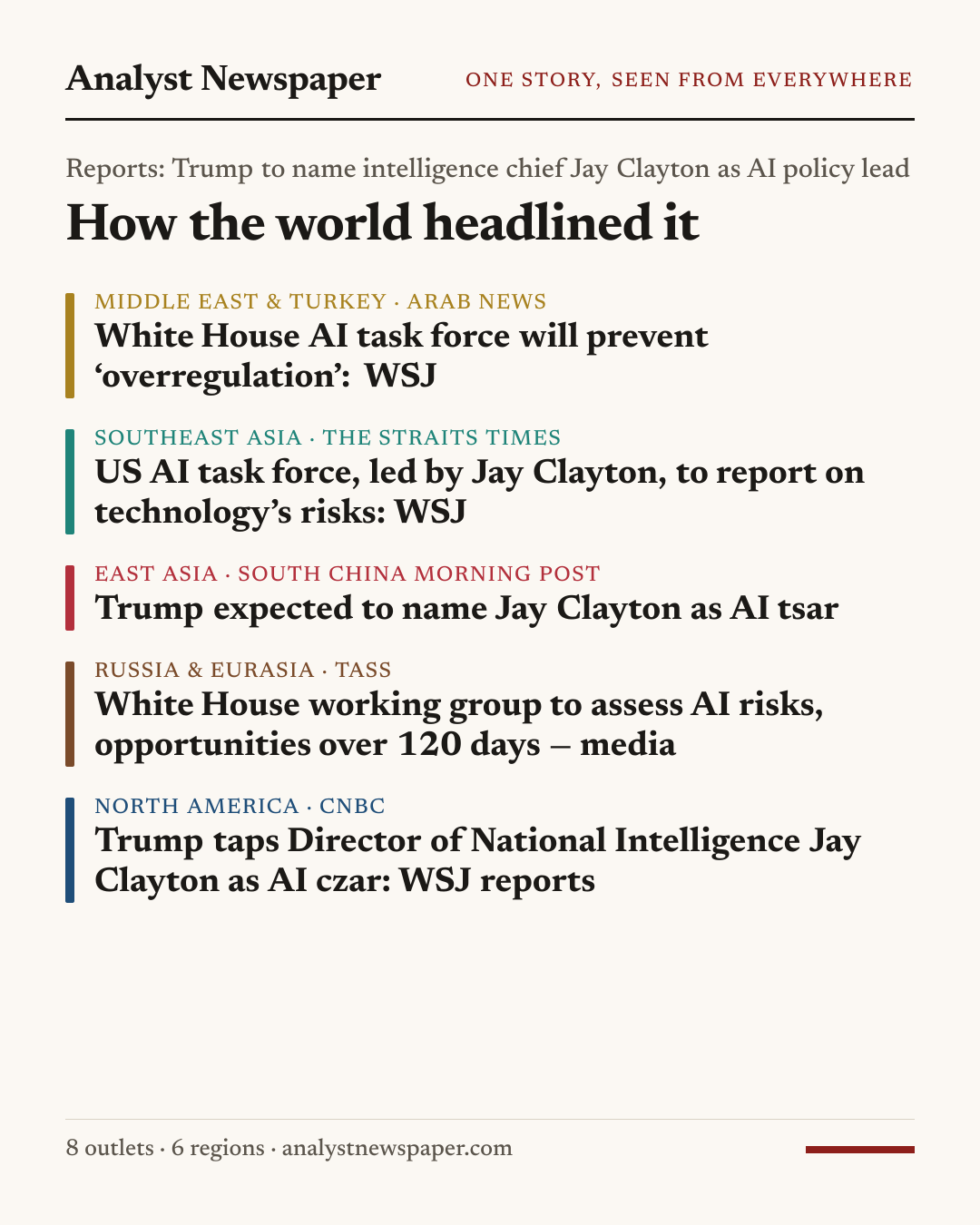
The task force's stated aim is to evaluate AI risks and opportunities while specifically preventing 'overregulation' that could hinder innovation.21
The Straits Times, citing WSJ
The task force is framed primarily as a mechanism with a concrete reporting mandate on the technology's risks and opportunities.15
Dawn
Coverage highlights researchers' vocal warnings about AI's potential dangers alongside the task force announcement.14
How it's framed
What each perspective puts first, based on headlines and summaries.
| Perspective | How it reads | What it puts first |
|---|---|---|
| US domestic outletsNorth America | US outlets such as TechCrunch and CNBC focus on the policy and personnel mechanics, framing the move as Trump's latest response to an ongoing AI safety debate and relaying WSJ reporting on Clayton's appointment.713 | AI safety debate, task force structure, WSJ sourcing |
| European public broadcasters and major outletsEurope | BBC, France 24, Deutsche Welle and The Guardian emphasize growing public worry over AI technology and provide biographical detail on Clayton, including his past SEC and prosecutorial roles and his Senate testimony calling AI a 'gamechanger' and 'a threat'. Le Monde offers a more neutral, biographical account of Clayton's new role without the same emphasis on public worry.416202311 | growing worries over technology, Clayton's biography, oversight concerns |
| Middle East and Turkey-based outletsMiddle East & Turkey | Coverage ranges from state-controlled Anadolu Agency framing the appointment as evidence of AI as a 'national security priority', to The Jerusalem Post's more supportive framing of US 'AI technology dominance', to Arab News emphasizing an anti-overregulation, pro-innovation stance drawn from WSJ reporting.61721 | national security priority, AI dominance, preventing overregulation |
| South Asian outletsSouth Asia | The Hindu, Dawn, NDTV and Indian outlets detail the task force's stakeholder outreach and note Clayton succeeds informal AI chief David Sacks, while Dawn highlights researcher warnings about AI dangers.8141824 | stakeholder outreach, succession from David Sacks, AI dangers |
| Southeast Asian outletsSoutheast Asia | The Straits Times and state-controlled CNA focus on the task force's concrete reporting mandate, specifically the 120-day deadline to report on AI risks, citing WSJ.1519 | 120-day reporting deadline, risk assessment |
| Russian state mediaRussia & Eurasia | TASS presents a neutral, descriptive account of Trump's own framing of the force's coordination role across government, industry and civil society, without added commentary.3 | coordination across sectors, Trump's own description |
| East Asian outletEast Asia | South China Morning Post frames the appointment through the lens of anticipation and process, noting it was 'expected' before confirmation and quoting a White House statement on personnel announcement protocol.2 | pre-announcement reporting, White House process |
| Latin American outletLatin America | Clarín describes the body in more institutional terms as a coordination committee for AI development, with minimal framing around risk or geopolitics.5 | institutional description, AI development coordination |
| African outletsAfrica | MyJoyOnline and Egypt Independent provide largely factual, neutral accounts of the announcement and the task force's stated goal of US leadership in AI, with limited additional framing.110 | factual announcement, US leadership in AI |
What the coverage leaves out
- None of the outlets reviewed reported reactions from AI companies, civil society or religious organizations named as stakeholders in the task force.
- None of the outlets reviewed detailed the specific powers, budget, or legal authority of the task force beyond its coordinating and reporting role.
- None of the outlets reviewed reported on reactions from Democratic lawmakers or AI safety advocacy groups to the appointment.
- Few outlets detailed who else, besides Clayton, will serve on the task force or panel.
Why it matters
Clayton was sworn in as the ninth Director of National Intelligence in August, following the departure of Tulsi Gabbard, and in that role oversees 18 US intelligence agencies.1220
Clayton previously served as the top federal prosecutor in Manhattan and led the Securities and Exchange Commission during Trump's first term.20
According to The National, Trump first floated the idea of a new AI chief and steering committee in September, amid ongoing debate over AI safety and oversight.12
Clayton will become the second person to hold the informal AI chief title, after venture capitalist David Sacks, who held the role earlier in Trump's second term before stepping down.18
What to watch
- The task force's report on AI risks and opportunities, due within 120 days according to WSJ reporting cited by several outlets.
- Further personnel announcements, which a White House official said will be made directly by the president, per South China Morning Post.
Sources (24)
Every outlet we drew on, grouped by where it is based. Read the originals for the full reporting.
North America
- 7TechCrunchUSPrivate
- 13CNBCUSPrivate
Trump taps Director of National Intelligence Jay Clayton as AI czar: WSJ reports
Latin America
- 5ClarínARPrivate
Translated from Spanish: Trump crea la "Fuerza de la Superinteligencia" para coordinar el desarrollo de Inteligencia Artificial en EE.UU.
Europe
- 4France 24FRPublic broadcaster
Trump names Jay Clayton as AI czar to lead 'Super Intelligence Force'
- 11Le MondeFRPrivate
In the United States, Jay Clayton, the new strong man of AI
Translated from French: Aux Etats-Unis, Jay Clayton, le nouvel homme fort de l’IA
- 16BBC News BusinessGBPublic broadcaster
Trump announces 'Super Intelligence Force' to oversee AI policy
- 20The GuardianGBPrivate
Trump names intelligence chief Jay Clayton as new White House AI czar
- 23Deutsche WelleDEPublic broadcaster
Russia & Eurasia
- 3TASSRUState-controlled
Middle East & Turkey
- 6Anadolu AgencyTRState-controlled
PROFILE - Jay Clayton: Trump’s intelligence chief becomes ‘AI czar’
- 12The NationalAEPrivate
Donald Trump says Jay Clayton will lead AI 'super intelligence' task force
- 17The Jerusalem PostILPrivate
Trump announces new 'Super Intelligence Force' to build US's AI technology dominance
- 21Arab NewsSAPrivate
White House AI task force will prevent ‘overregulation’: WSJ
Africa
- 1MyJoyOnlineGHPrivate
Trump unveils ‘Super Intelligence Force’ to oversee AI policy
- 10Egypt IndependentEGPrivate
South Asia
- 8The HinduINPrivate
Trump names national intelligence director Jay Clayton to lead a new federal AI task force
- 14DawnPKPrivate
- 18NDTVINPrivate
Trump Names National Intelligence Chief Jay Clayton As Head Of New AI Task Force
- 22The Express TribunePKPrivate
Trump names intelligence chief Clayton as AI czar, to head task force, WSJ reports
- 24The Economic TimesINPrivate
East Asia
- 2South China Morning PostHKPrivate
Southeast Asia
- 9Malay MailMYPrivate
Trump pushes Super Intelligence Force as America doubles down on AI supremacy over China
- 15The Straits TimesSGPrivate
US AI task force, led by Jay Clayton, to report on technology’s risks: WSJ
- 19CNASGState-controlled
Jay Clayton to lead Trump's AI task force, deliver report in 120 days, WSJ reports