SpaceX Acquires US Spectrum to Expand Starlink Mobile Toward Carrier Status
SpaceX has acquired low-band spectrum to expand Starlink Mobile, a move several outlets frame as a challenge to major US carriers, though reported details on cost and satellite approvals vary.
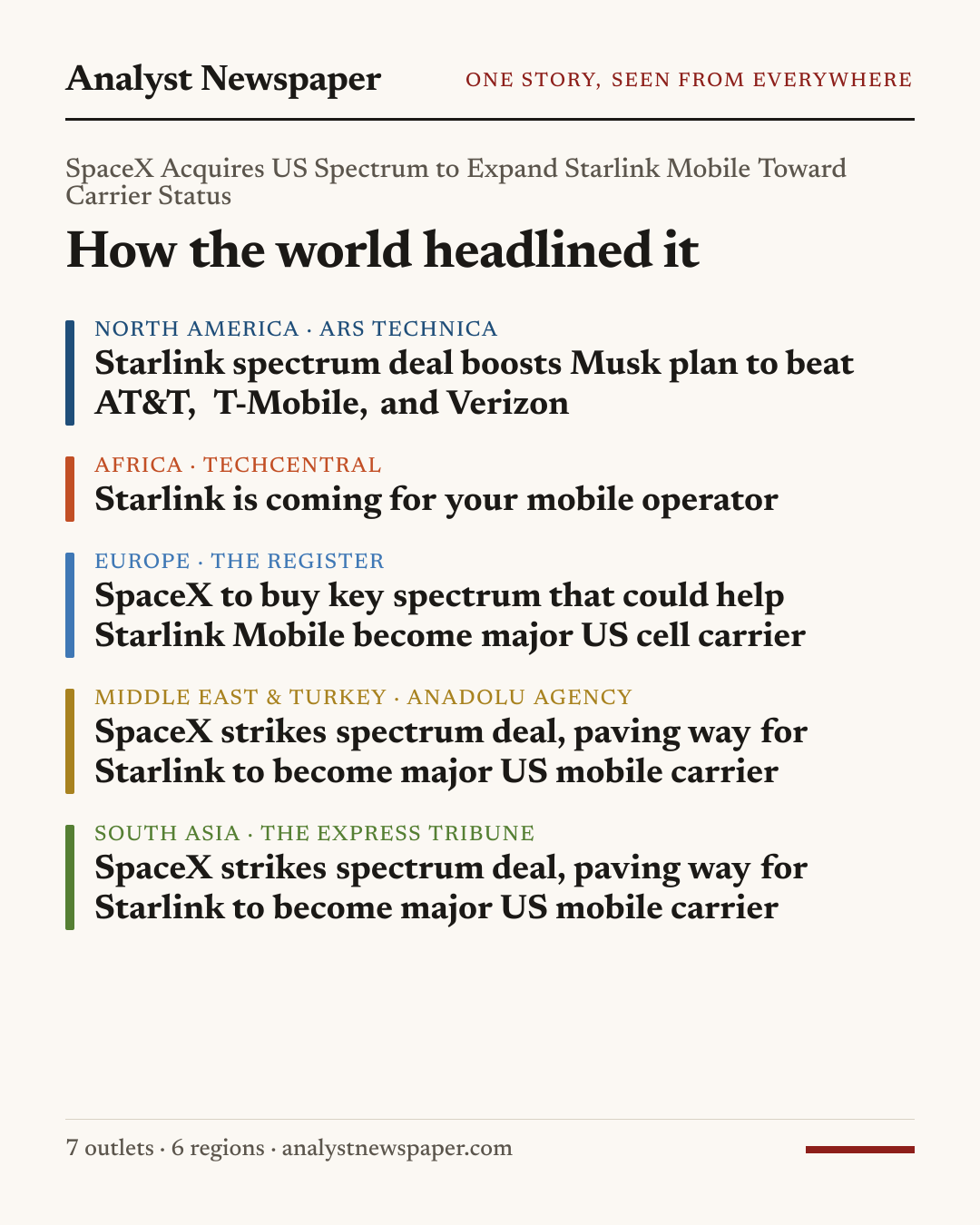
What happened
SpaceX has acquired a portfolio of low-band spectrum licenses in the United States intended to expand its Starlink Mobile service.2467
SpaceX says the move will pave the way for Starlink Mobile to become a major US mobile carrier, competing with companies like AT&T, T-Mobile, and Verizon.3457
One outlet reported SpaceX is paying $8 billion for 800MHz spectrum, while a state-controlled wire report said SpaceX claims a communications authority approved 15,000 next-generation satellites for direct-to-device service.135
SpaceX says deployment of its new satellite-to-mobile architecture depends on approval from the Federal Communications Commission.7
SpaceX says the deal requires approval from the Federal Communications Commission before deployment of its new architecture.7
What's agreed
Reported consistently by outlets in more than one region.
Where accounts differ
Each account is attributed to who makes it. We do not judge between them.
Cost of the spectrum deal
Satellite deployment approval
SpaceX, via Anadolu Agency and The Express Tribune
The communications authority has approved 15,000 next-generation satellites to deliver service directly to standard mobile devices.35
Other outlets reviewed
No mention of a specific satellite approval figure; coverage instead describes the deal as pending FCC sign-off.7
How it's framed
What each perspective puts first, based on headlines and summaries.
| Perspective | How it reads | What it puts first |
|---|---|---|
| US technology pressNorth America | Focuses on competitive implications for the US wireless market, naming AT&T, T-Mobile and Verizon as rivals, and on regulatory steps still required.47 | competition with major carriers, FCC approval pending, technical architecture |
| European technology pressEurope | Emphasizes the technical capabilities of the acquired spectrum, such as indoor penetration and extended coverage via satellite.2 | low-band frequency technical advantages, coverage beyond cell towers |
| State-controlled outletsMiddle East & Turkey | Reports the deal alongside a claim, attributed to SpaceX, that a communications authority approved a large satellite constellation for direct-to-device service.3 | regulatory approval, satellite constellation scale, major carrier ambition |
| South Asian press (syndicated)South Asia | Carries the same report as the Middle East state-controlled wire, including the satellite approval claim, without independent framing.5 | syndicated wire content, satellite approval claim |
| Southeast Asian state-controlled outletSoutheast Asia | Takes an explanatory approach, focusing on what low-band spectrum is rather than the competitive or financial stakes.6 | technical explainer, consumer-facing clarity |
| African private pressAfrica | Frames the story around a specific reported price tag and the threat to traditional mobile operators.1 | cost of deal, threat to telecom incumbents |
What the coverage leaves out
- None of the outlets reviewed reported a response from AT&T, T-Mobile, or Verizon to the spectrum deal.
- None of the outlets reviewed confirmed independently the $8 billion cost figure cited by only one source.
- None of the outlets reviewed detailed the timeline for FCC approval or the satellite deployment.
- None of the outlets reviewed reported on pricing, launch date, or service terms for the expanded Starlink Mobile offering.
Why it matters
Low-band spectrum can penetrate buildings and extend coverage beyond traditional cell towers, which could let Starlink offer indoor mobile coverage in a way competing services struggle to match.24
SpaceX reportedly plans to combine the acquired spectrum with its satellite-to-mobile constellation, a technical approach distinct from traditional cell tower networks.7
What to watch
- Whether the Federal Communications Commission approves the spectrum deal.
- Responses from established US carriers to the Starlink Mobile expansion.
- Further detail on the reported satellite deployment approval and its scale.
Sources (7)
Every outlet we drew on, grouped by where it is based. Read the originals for the full reporting.
North America
- 4Ars TechnicaUSPrivate
Starlink spectrum deal boosts Musk plan to beat AT&T, T-Mobile, and Verizon
- 7The VergeUSPrivate
Europe
- 2The RegisterGBPrivate
SpaceX to buy key spectrum that could help Starlink Mobile become major US cell carrier
Middle East & Turkey
- 3Anadolu AgencyTRState-controlled
SpaceX strikes spectrum deal, paving way for Starlink to become major US mobile carrier
Africa
- 1TechCentralZAPrivate
South Asia
- 5The Express TribunePKPrivate
SpaceX strikes spectrum deal, paving way for Starlink to become major US mobile carrier
Southeast Asia
- 6CNASGState-controlled
Explainer-What is the low-band spectrum that SpaceX acquired for Starlink Mobile