Tokyo court rules human voice a protected right in AI cloning case
A Tokyo court found that voice is a legally protected right in a case brought by a voice actor over AI cloning, but outlets differ on how they characterize the outcome for the actor himself.
What happened
A Tokyo District Court ruled that the human voice is a legally protected right in Japan, in a case tied to AI voice cloning.1234
The ruling came in a lawsuit filed by voice actor Kenjiro Tsuda, reported as the first Japanese case over voice rights infringement using generative AI.13
The case involved AI-generated clones of Tsuda's voice on TikTok.34
The Japan Times reported that while the court affirmed voice as a protected right, it dismissed Tsuda's specific case.1
What's agreed
Reported consistently by outlets in more than one region.
Where accounts differ
Each account is attributed to who makes it. We do not judge between them.
How it's framed
What each perspective puts first, based on headlines and summaries.
| Perspective | How it reads | What it puts first |
|---|---|---|
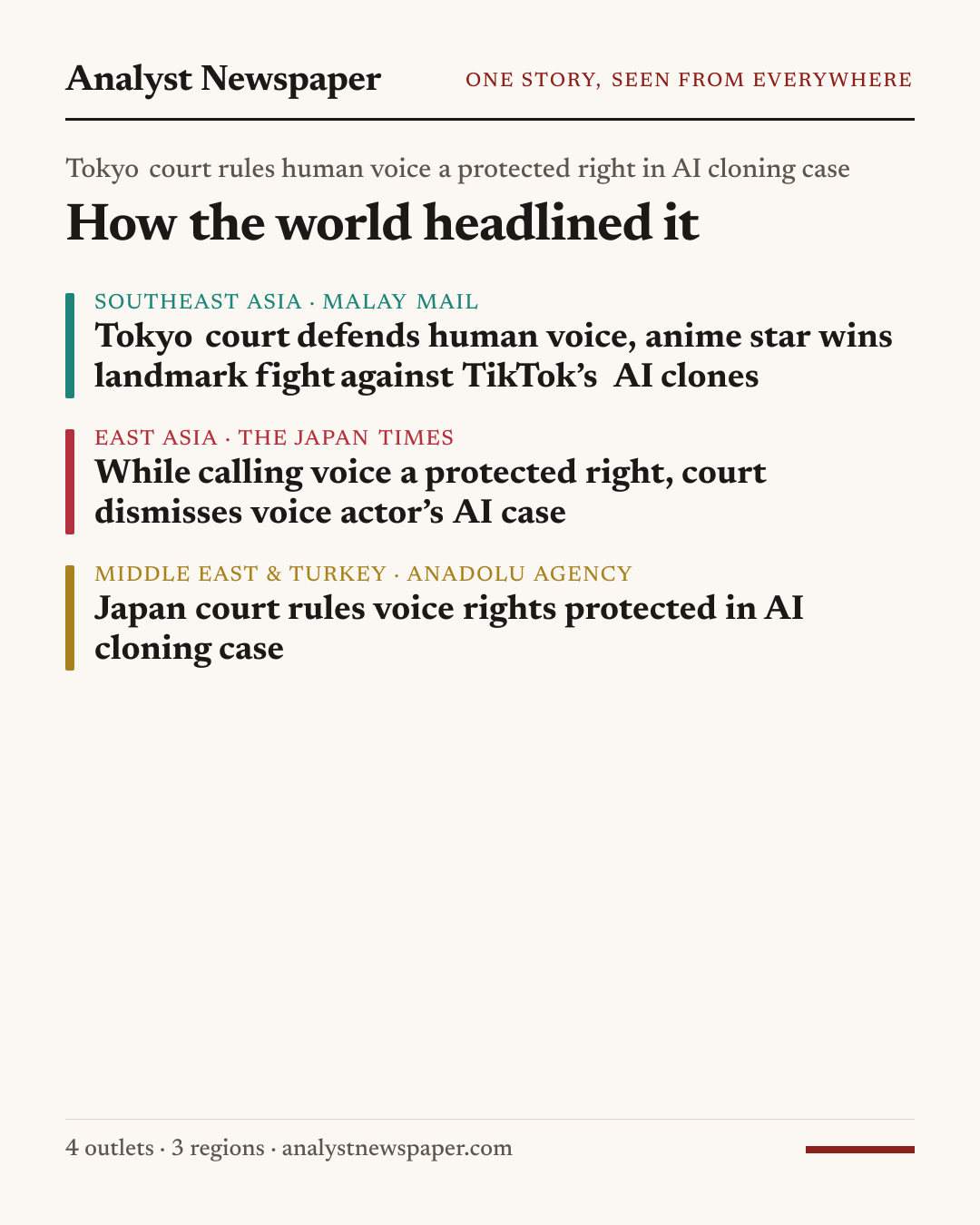
| Japanese domestic pressEast Asia | The Japan Times frames the ruling as a mixed outcome, emphasizing that the court dismissed the voice actor's case even while affirming voice as a protected right.1 | dismissal of case, legal nuance |
| State-controlled wire and broadcast outletsMiddle East & Turkey | Anadolu Agency presents the ruling straightforwardly as a court decision protecting voice rights, without detail on the case's specific disposition.2 | court ruling, voice rights protected |
| Southeast Asian outletsSoutheast Asia | Malay Mail and CNA both frame the ruling around the TikTok AI cloning angle, with Malay Mail using celebratory language describing a 'landmark fight' won against AI clones, while CNA states the finding neutrally.34 | TikTok AI clones, celebratory framing (Malay Mail), neutral framing (CNA) |
What the coverage leaves out
- None of the outlets reviewed detailed the court's full legal reasoning or the specific statute or precedent invoked.
- None of the outlets reviewed reported on TikTok's response to the ruling.
- None of the outlets reviewed clarified how the recognition of voice as a protected right coexists with the dismissal of Tsuda's specific claim, beyond The Japan Times' brief mention.
- None of the outlets reviewed indicated whether Tsuda or any party plans to appeal.
Why it matters
The case is described as the first lawsuit in Japan over alleged voice rights infringement using generative AI, raising questions about how existing law applies to AI voice cloning.1
Sources (4)
Every outlet we drew on, grouped by where it is based. Read the originals for the full reporting.
Middle East & Turkey
- 2Anadolu AgencyTRState-controlled
East Asia
- 1The Japan TimesJPPrivate
While calling voice a protected right, court dismisses voice actor’s AI case
Southeast Asia
- 3Malay MailMYPrivate
Tokyo court defends human voice, anime star wins landmark fight against TikTok’s AI clones
- 4CNASGState-controlled
Japan court rules human voice is protected in TikTok AI case