US Treasury yields surge to multi-year highs amid global bond sell-off
Bond yields hit multi-year and, in some cases, multi-decade highs, but outlets differ on how alarming the trend is and what it signals for growth, inflation and recession risk.
What happened
US Treasury yields climbed sharply, with the 10-year yield touching about 5.1% (per Le Monde) to 5.145% (per The Economic Times), levels last seen since around 2007, and the 30-year yield reaching its highest since 2004 at 5.444%, according to The Economic Times.58
The rise came amid a broader global bond sell-off and followed data showing stronger-than-expected US economic growth and persistent inflation pressures.589
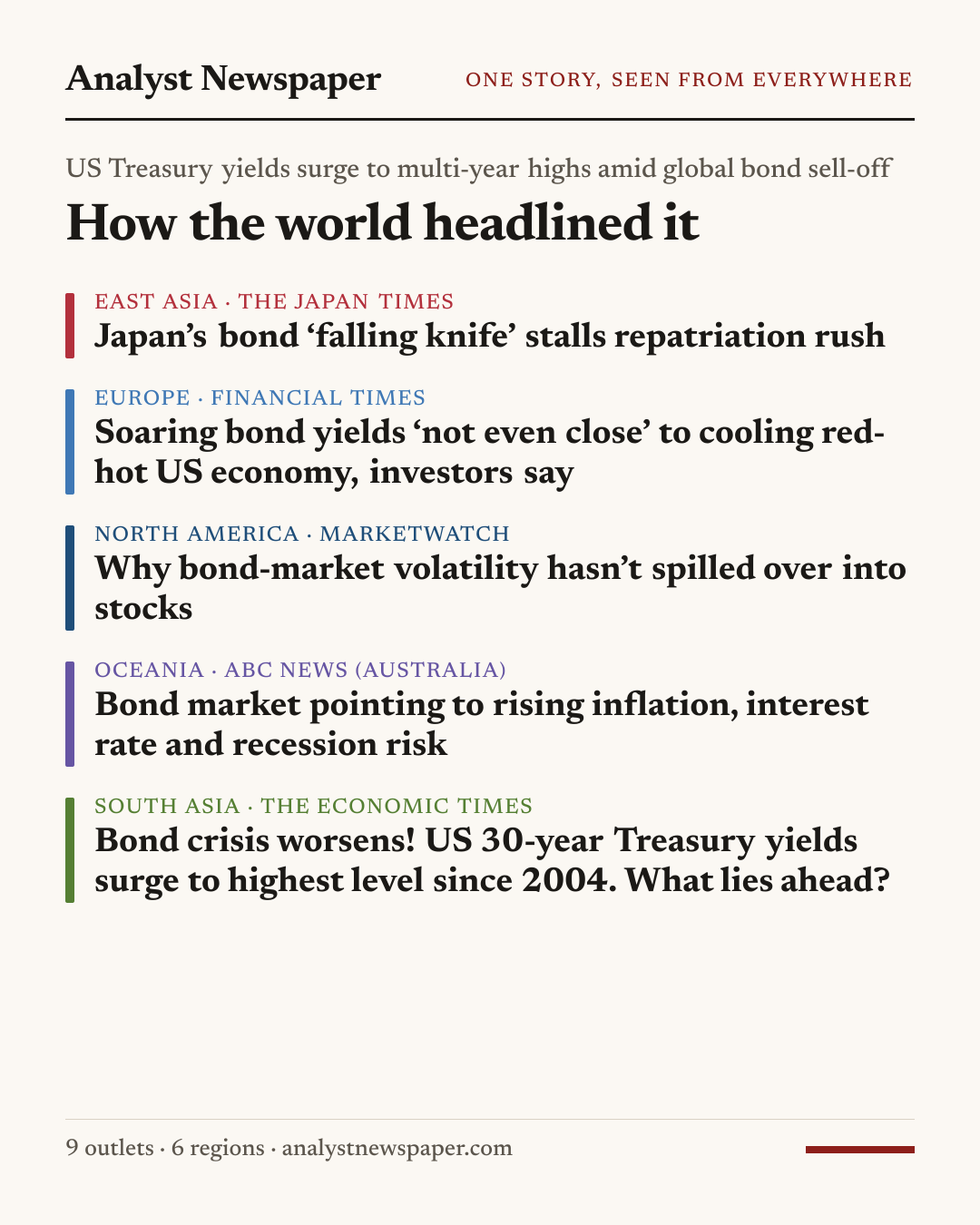
Analysts and outlets differ on the implications: the Financial Times reports the US economy showing no signs of slowing despite higher borrowing costs, while ABC News warns of rising recession and inflation risks.24
The yield surge has had ripple effects internationally, including hesitancy among Japanese bond investors, according to The Japan Times; a Nikkei Asia headline also linked the global sell-off to housing markets, though no further detail was available in the snippet reviewed.17
What's agreed
Reported consistently by outlets in more than one region.
- US Treasury yields rose sharply, with the 10-year yield reaching roughly 5.1% to 5.145%, its highest level in about 16 years; sources reported slightly different peak figures for the 10-year yield on different days.58
- The rise in yields followed a broader global bond sell-off.89
- Strong US economic data, including growth and inflation figures, contributed to the yield surge.589
Where accounts differ
Each account is attributed to who makes it. We do not judge between them.
Severity and implications of the yield surge
The Economic Times (India)
Describes the situation as a worsening 'bond crisis' with yields hitting multi-year highs, using alarmed language such as 'crisis' and 'surge'.5
ABC News (Australia), public broadcaster
Frames the yield rise as a warning sign of rising inflation, interest rate and recession risk, with the financial 'squeeze' set to worsen before improving.4
Whether elevated yields signal broader inflation concern
ABC News (Australia)
States bond yields are the highest in 20 years and frames this as inflation fears ripping through global markets.4
CNA (Singapore), state-controlled
Reports, per its headline, that yields remain elevated as inflation fears keep markets on edge, without elaboration in the available snippet.6
How it's framed
What each perspective puts first, based on headlines and summaries.
| Perspective | How it reads | What it puts first |
|---|---|---|
| US financial outletsNorth America | Focus on the mechanics of the yield rise, noting stronger-than-expected economic data and that stock markets have so far been insulated from bond market turbulence.39 | economic resilience, limited spillover to stocks, data-driven rate moves |
| Financial Times (UK)Europe | Emphasizes that despite rising yields, the US economy has shown no clear sign of cooling, describing conditions as 'red-hot'.2 | economic resilience, no sign of slowdown |
| Le Monde (France)Europe | Emphasizes the historical scale of the yield increase, noting it is the highest since July 2007, and links it to economic strength, oil prices and expected Federal Reserve policy.8 | highest since 2007, oil prices, Fed policy trajectory |
| East Asian financial pressEast Asia | Highlight international spillover effects, particularly hesitancy in Japan's bond market and, per a Nikkei Asia headline, effects on housing markets, framing the US yield surge as part of a broader global bond sell-off.17 | global contagion, Japan bond market uncertainty, housing market impact (headline only) |
| South Asian financial pressSouth Asia | Use dramatic, alarmed language describing a 'bond crisis' and stressing specific record-high yield figures.5 | crisis framing, record yield levels, market selloff |
| Southeast Asian state-controlled outletSoutheast Asia | Presents a brief, headline-only account emphasizing that elevated yields are keeping markets 'on edge' due to inflation fears, without further elaboration in the available snippet.6 | market caution, inflation concerns |
| Oceania public broadcasterOceania | Frames the yield rise as a broader warning sign for inflation, interest rates and recession risk, using vivid language about fears 'ripping through' markets.4 | recession risk, inflation warning, financial squeeze |
What the coverage leaves out
- None of the outlets reviewed reported an official response from the US Federal Reserve or Treasury Department to the yield surge.
- None of the outlets reviewed provided detailed data on how the yield rise has affected specific sectors beyond housing and bond markets.
- None of the outlets reviewed reported on how policymakers outside the US are responding to the global bond sell-off.
Why it matters
The 10-year Treasury yield underpins pricing for a wide range of global financial assets, so its rise affects borrowing costs worldwide.5
Rising yields have been linked to hesitancy in Japan's bond market, according to The Japan Times, and a Nikkei Asia headline linked the global sell-off to effects on housing markets, though its snippet gave no further detail.17
What to watch
- Further US economic data releases on growth and inflation, which markets are watching for signs of whether yields will continue rising
- Potential Federal Reserve policy responses to sustained high yields
- Whether bond market volatility begins to spill over into equity markets
Sources (9)
Every outlet we drew on, grouped by where it is based. Read the originals for the full reporting.
North America
- 3MarketWatchUSPrivate
- 9CNBCUSPrivate
Europe
- 2Financial TimesGBPrivate
Soaring bond yields ‘not even close’ to cooling red-hot US economy, investors say
- 8Le MondeFRPrivate
In the United States, economic strength and expensive oil trigger a new surge in rates
Translated from French: Aux Etats-Unis, la vigueur de l’économie et le pétrole cher provoquent une nouvelle poussée des taux
South Asia
- 5The Economic TimesINPrivate
Bond crisis worsens! US 30-year Treasury yields surge to highest level since 2004. What lies ahead?
East Asia
- 1The Japan TimesJPPrivate
- 7Nikkei AsiaJPPrivate
Southeast Asia
- 6CNASGState-controlled
Oceania
- 4ABC News (Australia)AUPublic broadcaster
Bond market pointing to rising inflation, interest rate and recession risk